
Physics - Vertical Motion
OPENING QUESTION: Please reflect on yesterday's formative quiz. What part of falling object problems are working well for you? What parts are still giving you indigestion?
ARNING OBJECTIVES:
- I will continue to evaluate my ability to solve falling object problems during today's class
CALENDAR:
Vertical motion test on Thursday (NOT to include projectile motion)
WORDS O' THE DAY:
- gravity! gravity! gravity!
FORMULAE OBJECTUS:
-
a = (vf - vi)/(tf - ti) (definition of acceleration)
- g = 9.81 m/s2 (acceleration an object experience on Earth) ONLY present in vertical motion (Y axis) problems
1) vfy = viy +agt
2) yf = yi + viyt + 1/2agt2
3) vfy2 - viy2 = 2ag∆y
Let's get the book problems (#40, 42 and 43) knocked out in the next 30 minutes or so
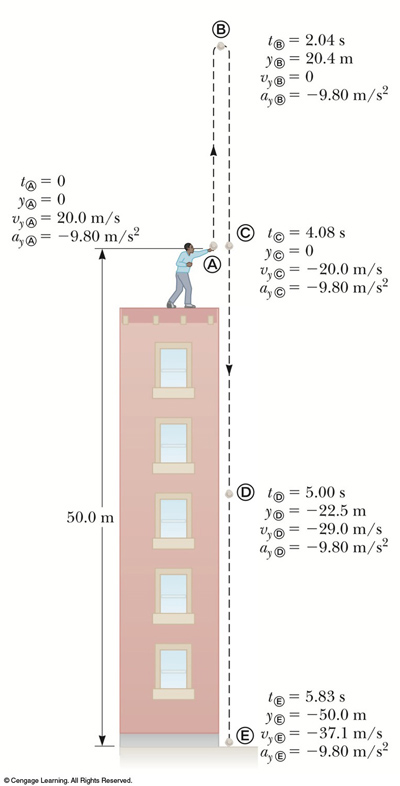
Let's go back to this MOST informative (AND COMPLEX) graphic of a falling object problem:
 |
There are a couple of things to keep in mind when we evaluate motion in 1 dim (vertically):
Here's a pretty complex graphic. Look at JUST parts A and B. What can you determine from the values shown there? |
Let's take a look at a couple of practice problems in our book: #40, 42 and 43.